Reading the USDA Plant Hardiness Map for Nebraska Beds
Choosing plants for a Nebraska bed can feel confusing when a catalog lists one hardiness zone and your yard seems to experience a different winter. The USDA Plant Hardiness Zone Map is useful, but it answers a narrow question: how cold winters typically get in a location. Here’s how to read it, apply it to plant choices, and avoid treating a zone like a planting calendar.
What the USDA Plant Hardiness Zone Map Measures
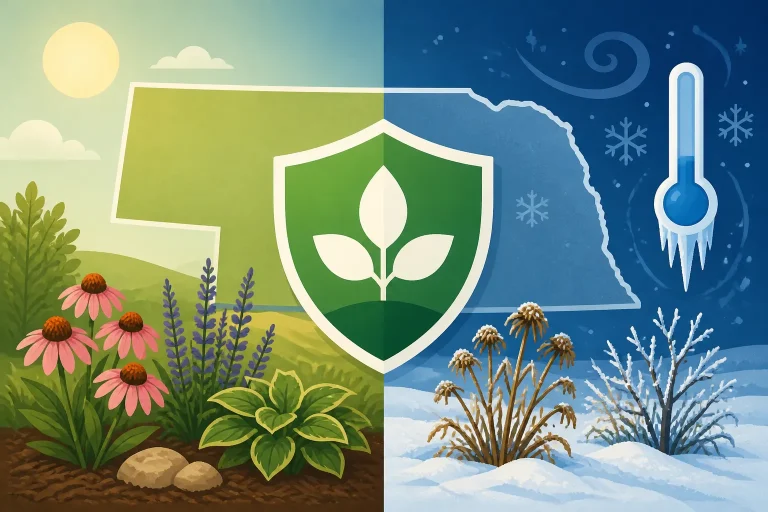
The USDA Plant Hardiness Zone Map groups locations according to their average annual extreme minimum winter temperature. In other words, it uses historical weather observations to estimate the coldest temperature a location reaches in a typical year—not the coldest temperature it could ever reach.
That distinction matters. A hardiness zone is a measure of long-term winter cold, not a promise about the weather in any particular season. An unusually cold winter can fall below the range suggested by a location’s zone. A mild winter can stay well above it. The zone describes a pattern in past weather, not a guarantee for your garden.
The map divides the temperature scale into zones and half-zones. Each full zone covers a range of 10 degrees Fahrenheit; the “a” and “b” subdivisions split that range into 5-degree bands. A plant label may list a zone range to indicate where the plant is generally expected to tolerate winter cold when established and grown under suitable conditions.
For example, a label might say a perennial is hardy in a set of zones. That range is a screening tool: it can help you decide whether the plant is a reasonable candidate for your area. It does not mean the plant will thrive in every yard that falls within those zones. Nor does it describe the plant’s needs for sun, soil moisture, drainage, wind protection, or summer heat.
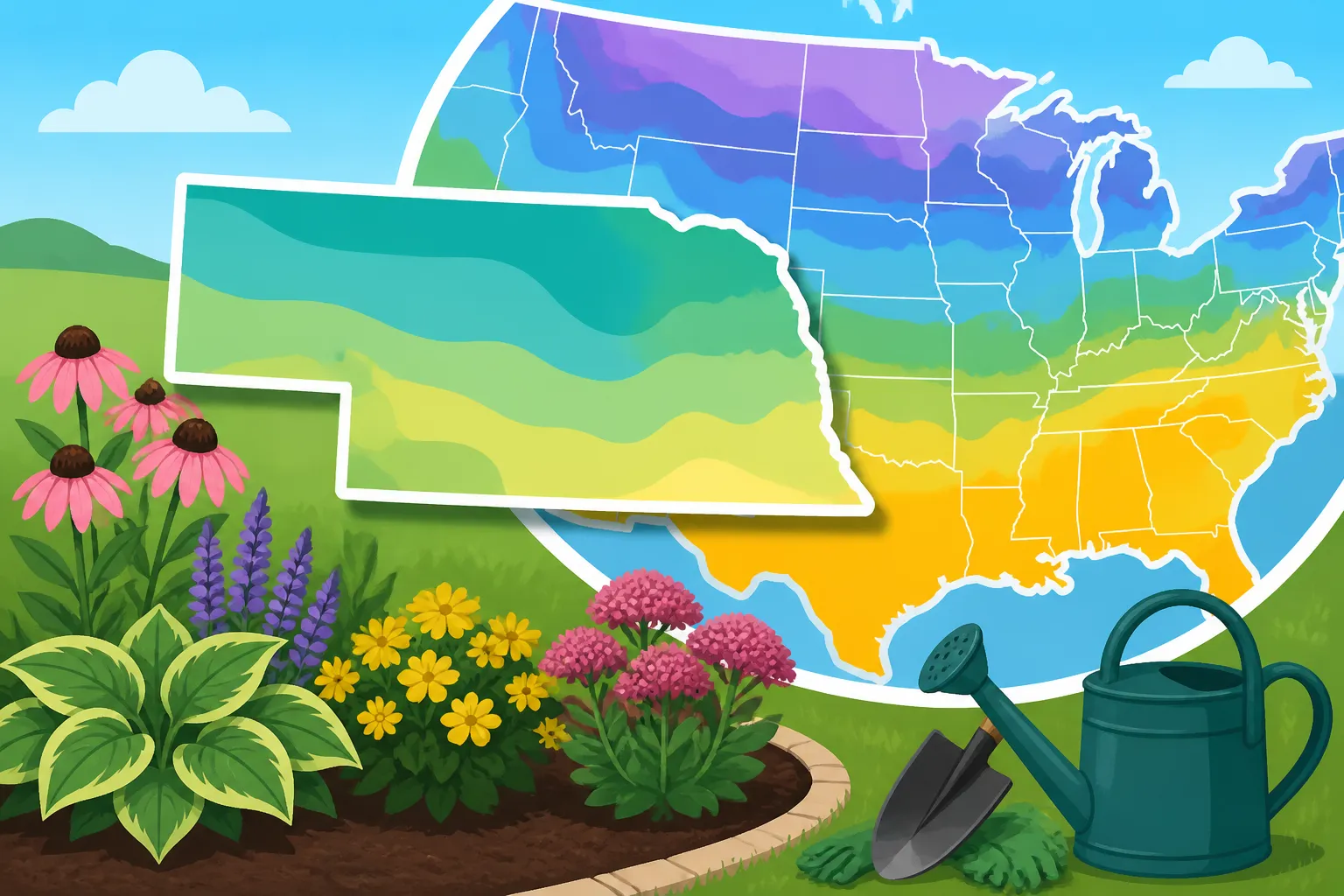
The map also does not show the coldest possible temperature in each place. It is based on average annual extreme minimum temperatures over a period of weather records. The map’s colors make regional patterns easier to see, but the temperature boundary between two zones is not a wall. A yard near a zone line may experience winter conditions similar to yards on either side.
For Nebraska gardeners, the map is most helpful when comparing the general winter cold expected in different parts of the state or checking whether a perennial or woody plant is likely to be cold-hardy. It is less useful as a way to choose the date for sowing vegetables, setting out seedlings, or uncovering plants in spring.
Before acting on a map color, make sure you understand what the plant’s hardiness rating means and what the map leaves out. How to Find the Hardiness Zone for Your Nebraska Town offers a useful next step if you want to check the zone associated with a particular community.
How to Find the Zone for a Nebraska Garden
Start with the map’s location search, not a broad guess based on the nearest city. Enter a ZIP code or town name, then check the map closely enough to see the zone shading and any boundary nearby. ZIP codes and town names are convenient starting points, but neither describes the exact growing conditions of every yard in that area.
A ZIP code can cover land with more than one set of local conditions. A town’s center, its outer neighborhoods, nearby open country, and a sheltered valley may differ in winter exposure even if they share a mailing address. The map is a regional planning tool, so do not treat a ZIP-code result as a precise measurement for an individual bed.
When the search result is close to a zone boundary, look at the map at its available detail and compare nearby areas. It can help to check more than one map view or location result. If a garden seems to fall near a boundary, it is sensible to choose plants that can tolerate the colder of the neighboring zones rather than relying on the warmer label alone.
This is especially practical for plants that are expensive, slow to establish, or difficult to replace, such as trees, shrubs, and long-lived perennials. For a low-cost annual flower bed that is replanted each year, a close boundary may be less consequential. The choice depends partly on the investment and the consequences of losing the plant.
Keep the map result in context. The zone associated with a town is not a customized forecast for your yard, and a zone label should not be read as an instruction to plant on a certain day. To look up an area in more detail, see Finding Plant Hardiness for Nebraska ZIP Codes is not valid internal link formatting—Wait! Need bracketed exact title alone. (Oops must output only exact bracket title, no embedded link syntax. Correct craft: “The map can help narrow the search, and Finding Plant Hardiness for Nebraska ZIP Codes explains…” Ensure no extra text after bracket.)
Use the same care with plant tags and online listings. A listing’s hardiness range usually refers to winter survival under favorable growing conditions. It may not account for a windy site, poor drainage, lack of snow cover, or sudden temperature swings. If a plant sits near the colder edge of its stated range, look for more information about its specific needs before dedicating a bed to it.
If you are comparing two plants, compare more than their zone labels. One may tolerate colder winters but require well-drained soil, while another may tolerate wetter soil but be less cold-hardy. A plant that is an excellent match for one yard can be a poor choice for another only a short distance away.
Use the Zone to Screen Plants, Not to Plan Every Bed
The hardiness zone is a useful first filter when choosing plants that stay in the ground through winter. It helps answer, “Is this plant likely to survive the winter cold here?” It does not answer, “Will this plant thrive in this bed?”
For a perennial or woody plant, check the listed hardiness range against the zone for your area. If your location is within the range, the plant may be suitable from a winter-cold perspective. Then consider whether the bed also meets the plant’s requirements for sunlight, soil, drainage, and moisture. A hardy plant can still struggle if it is planted in a site that stays waterlogged, dries rapidly, or receives the wrong amount of sun.
If the location is at the cold edge of a plant’s range, treat the choice as a higher-risk experiment. You might try one plant before buying several, select a protected site, or choose a hardier alternative for the main bed. Be clear about what protection can and cannot do. Mulch or a sheltered position may buffer some stresses, but they do not change the official zone or guarantee survival during severe cold.
The zone can also help set expectations. A plant listed as hardy in warmer zones may survive a mild winter in a colder area and then fail when a more severe winter arrives. One successful season is not proof that a plant is reliably suited to a site. Likewise, a plant that dies after a winter may have been affected by more than temperature: waterlogged soil, drought before freezing, wind exposure, or a sudden freeze after warm weather can all contribute.
When choosing between similar plants, look for a hardiness rating that offers a comfortable margin rather than relying on the warmest edge of the plant’s range. That is particularly useful for permanent plantings and for beds where replacing a failed plant would be difficult. But don’t let the zone number make the decision by itself. A plant with a suitable rating can still be a poor fit for your particular soil or light.
Perennials and shrubs
Perennials, shrubs, and trees are among the plant groups for which hardiness zones are most useful. These plants remain outdoors through winter, so the minimum temperature they can tolerate is a meaningful part of the selection process.
Even so, the rating describes a plant’s potential under appropriate conditions, not a guarantee for every specimen. A young plant may be more vulnerable than an established one. A plant in a container may experience colder root conditions than one planted in the ground. A plant exposed to wind or planted in wet soil may fare differently from one growing in a sheltered, well-drained bed.
For a new bed, consider the whole planting area before choosing a collection of plants based only on their labels. Nebraska Vegetable Garden Planning: Site, Soil, and Sun covers general bed-planning considerations that also help when you’re choosing a location for ornamentals. The same site assessment—sun exposure, soil, drainage, and space—can help prevent the common mistake of selecting a cold-hardy plant that is otherwise mismatched to the bed.
Bulbs and plants with special winter needs
A hardiness rating is one part of winter planning for bulbs and other plants that may need specific conditions. Soil drainage, planting depth, moisture, and the timing of growth can affect whether a plant persists. A zone match does not make a poorly drained bed suitable for a plant that needs the soil to drain well.
For these plants, check instructions for the plant type as well as the zone range. Look for details about whether the plant should remain in the ground, whether it needs winter protection, and what conditions may cause it to rot or dry out. When instructions conflict, the more specific guidance for that plant is usually more useful than a broad zone label.
What the Map Does Not Tell You About Vegetable Planting
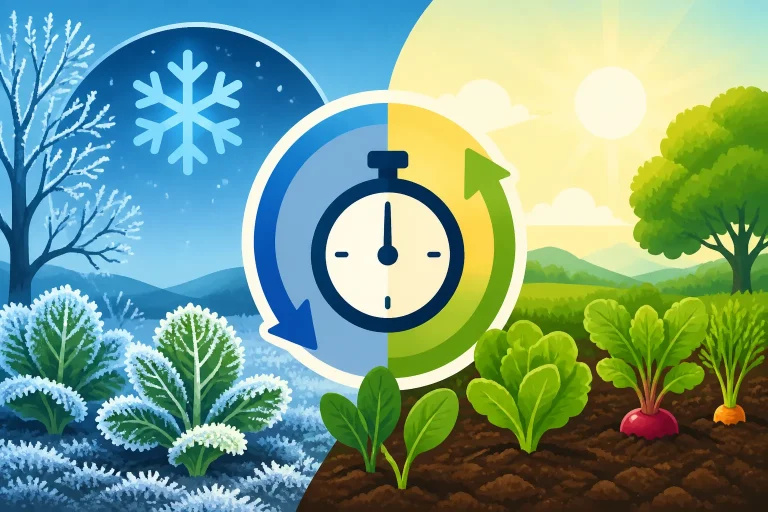
Vegetable gardeners often see hardiness zones and assume they can use them to decide when to plant. That is a different question. The map describes winter cold patterns; it does not tell you when soil is warm enough, when a late spring freeze is likely, or when an individual crop can tolerate outdoor conditions.
Vegetables vary in their needs. Some crops can be sown or transplanted into cool conditions, while others need warmer soil and air. A plant’s ability to survive a typical winter says little about whether a seed will germinate well in cold ground or whether a young transplant will tolerate a late freeze.
For instance, a vegetable that grows as an annual is generally planted for one season rather than expected to survive a Nebraska winter in the bed. Its outdoor timing depends on crop type, soil conditions, and short-term weather—not simply on the hardiness zone. A zone number cannot replace the crop-specific timing in Nebraska Vegetable Planting Calendar: From Spring Thaw to Fall.
The distinction applies at the end of the season, too. A hardiness zone does not tell you when the first frost will reach your neighborhood, how severe a particular freeze will be, or whether a crop should be harvested before a cold night. Those decisions depend on local forecasts, the crop’s cold tolerance, and the condition of the plant.
Use separate tools for separate questions:
| Gardening question | Useful information |
|---|---|
| Is this perennial or shrub likely to survive winter cold? | The plant’s hardiness range and the USDA zone for your area |
| When should a vegetable be sown or transplanted? | Crop-specific planting guidance, soil conditions, and the forecast |
| Could a late spring freeze harm a tender plant? | Local weather forecasts, plant sensitivity, and available protection |
| When should fall vegetables be planted? | Crop days to maturity and the expected growing window |
| Will this bed suit a plant? | Sun, soil, drainage, moisture, wind, and space |
A vegetable garden also changes from year to year. Soil warms at different rates depending on texture, moisture, exposure, bed construction, and recent weather. A raised bed may warm earlier than surrounding ground but can also dry out faster. A sheltered south-facing area may feel warmer than a low, exposed spot. None of these differences changes the hardiness zone printed on a map, but they can influence planting success.
For a broader explanation of why hardiness ratings do not set vegetable dates, see Why Plant Hardiness Zones Do Not Dictate Vegetable Planting Dates. If your concern is the risk of a cold snap rather than average winter survival, Planning Vegetable Beds Around Unpredictable Late Spring Freezes addresses that separate problem.
Read Your Yard’s Microclimates Alongside the Map
A state or regional map cannot show the conditions of every garden bed. The space immediately around a home can include warmer, colder, windier, wetter, and drier spots. These small differences are called microclimates. They do not change a location’s official zone, but they can affect how a plant performs.
A bed beside a sheltered wall may be less exposed to wind than an open area. A sunny, protected corner can warm faster on a spring afternoon. A low spot may collect cold air on a calm night, while a slope with unobstructed air movement may drain cold air away more readily. Trees, buildings, fences, paving, and changes in elevation can all influence conditions.
These differences are not simple guarantees. A wall that provides shelter can also reflect heat, creating stressful conditions for a plant that prefers cooler soil. A paved area may warm quickly but provide little moisture. A low site may be more exposed to cold-air pooling, but its soil could also stay moist longer. Evaluate what is actually happening in the bed instead of assuming one feature always helps.
Observe before you plant
Spend time noticing how the garden behaves through the seasons. Which beds thaw first? Where does snow linger? Which areas dry out quickly after rain? Where does wind hit hardest? Do some plants leaf out sooner in one part of the yard? Keep brief notes or take photographs from the same locations at different times.
This observation is particularly helpful when a bed sits near a map boundary or when a plant is being considered near the cold edge of its hardiness range. A plant that needs reliable winter protection may be a better candidate for a sheltered, well-drained location than an exposed bed. Still, a protected location is not a substitute for checking the plant’s needs.
If winter survival is important, record losses as well as successes. A plant that survives one winter in a sheltered spot has not necessarily demonstrated that it will tolerate a more exposed position. Notes can help distinguish a repeated pattern from a single unusual season.
Consider soil and water
Cold hardiness is not the only winter stress. Soil that stays saturated can damage roots, and a plant stressed by dryness may be less resilient. Drainage, soil structure, and watering habits are part of the conditions a plant experiences before, during, and after winter.
A bed’s surface can give a misleading impression. Soil that looks dry at the top may be moist below, while a recently watered surface can conceal deeper dry layers. Pay attention to the bed’s drainage after rain and to how quickly it dries during warm, windy periods. For soil preparation and testing considerations, see Improving Nebraska Garden Soils: Testing, Amendments, and Mulch.
Mulch can help moderate soil moisture and temperature, but it is not a way to reclassify a garden into a warmer zone. Use a mulch appropriate to the plant and bed, and avoid piling material against stems or trunks. If a plant requires a particular winter treatment, follow guidance specific to that plant rather than assuming mulch alone will meet the need.
Keep records without overreading one winter
A garden journal can make map information more useful over time. Record the location of each plant, its hardiness rating, exposure, soil conditions, and whether it made it through winter. Add notes about unusual cold, strong winds, wet soil, or winter protection when relevant.
A single failure does not prove that the map is wrong or that a plant can never grow in your yard. It may point to a site mismatch, a drainage issue, or a particular weather event. A single success does not prove the plant is dependable either. Repeated observations across seasons give a more useful picture.
For additional context about local seasonal extremes, see Managing Seasonal Temperature Extremes Across Nebraska Yards. The map offers a broad baseline; your own observations help explain what happens in a specific bed.
A Practical Workflow for Using the Map Before Planting
The most useful approach is to treat the map as one part of a plant-selection process. You do not need to identify a perfect zone for every square foot of garden. You do need to know what the map can tell you, check the plant’s needs, and consider the actual site.
-
Look up the garden’s general location. Search by town or ZIP code, then inspect the map rather than stopping at a single search result. If the location is close to a zone boundary, compare nearby map areas and consider the colder neighboring zone when choosing long-lived plants.
-
Check the plant’s hardiness range. Use the range provided for the specific plant, not a general assumption based on its common name. If your area falls within the range, winter cold may be suitable under favorable conditions. If it sits at the plant’s limit, treat the choice as less certain.
-
Identify how long the plant stays outdoors. A perennial, shrub, or tree needs to survive local winters. A vegetable grown as an annual has a different timing problem: it needs suitable conditions during the growing season. Don’t use a perennial hardiness rating as a vegetable planting date.
-
Read the rest of the plant information. Check sunlight, soil moisture, drainage, mature size, and any special winter requirements. A zone match is not a substitute for those details.
-
Compare the plant with the exact bed. Consider exposure to wind, nearby buildings, slope, low spots, soil moisture, and shade. A plant that may be marginal across a wide area could have a better chance in a suitable protected location, while a normally hardy plant can struggle in a poorly drained or exposed bed.
-
Choose how much risk you can accept. For a large planting or a permanent landscape feature, favor plants with a comfortable hardiness margin. For a small trial, you may decide to test one plant that is near its limit. Do not assume that a warmer microclimate will always prevent winter injury.
-
Use a calendar for seasonal tasks. For vegetable sowing and transplanting, use crop-specific guidance and local conditions. For freeze protection or fall harvest decisions, consult the forecast and information on the crop’s tolerance. A hardiness map is not designed to provide those dates.
-
Review the outcome and adjust. Note whether plants survived, how the site behaved, and what conditions may have contributed to success or failure. Use those observations alongside the map when choosing what to plant next.
This process prevents two opposite mistakes: dismissing a plant that may suit a protected bed, and assuming that a map color guarantees success. It also helps separate permanent plant choices from seasonal planting decisions. If your main question is whether to plant vegetables now, a calendar and current conditions are more relevant than the zone result. If you are deciding whether a shrub is likely to overwinter, the zone is an important starting point.
For seasonal planning, Nebraska Spring Freeze Dates: Comparing East, Central, and West can help frame why local freeze risk deserves separate consideration. And if you are deciding whether a warmer map result changes what can survive in a landscape, Does a Warmer Nebraska Zone Guarantee Perennial Survival? is a useful companion topic.
Frequently Asked Questions
Does my Nebraska hardiness zone tell me when to plant vegetables?
No. It describes average annual extreme minimum winter temperature, not soil warmth, frost dates, or the needs of individual crops. Use crop-specific planting guidance and current local conditions to choose sowing and transplanting times.
Can two gardens in the same ZIP code have different growing conditions?
Yes. A ZIP code is a broad location marker, while wind, slope, buildings, drainage, and exposure can create different conditions within a neighborhood. The map provides regional context, not a yard-by-yard measurement.
Should I choose plants for the warmer zone if my yard sits near a boundary?
For long-lived plants, choosing options that tolerate the colder neighboring zone is generally the lower-risk approach. If you want to try a plant near the warmer edge of its range, consider its site needs and treat the outcome as less certain.
If a plant survives one winter, does that prove it is hardy here?
Not necessarily. One winter may be milder than usual, and a sheltered location can affect a plant’s experience. Repeated results and notes about the bed’s exposure, drainage, and winter conditions provide a better basis for future choices.
Disclaimer
This article is for general informational purposes only and does not constitute professional advice. Laws, prices and regulations vary by location and change over time. Consult a qualified professional for guidance on your specific situation. Nebraska Gardening Guide is not a government agency and is not affiliated with any university extension, state department of agriculture or other government agency.