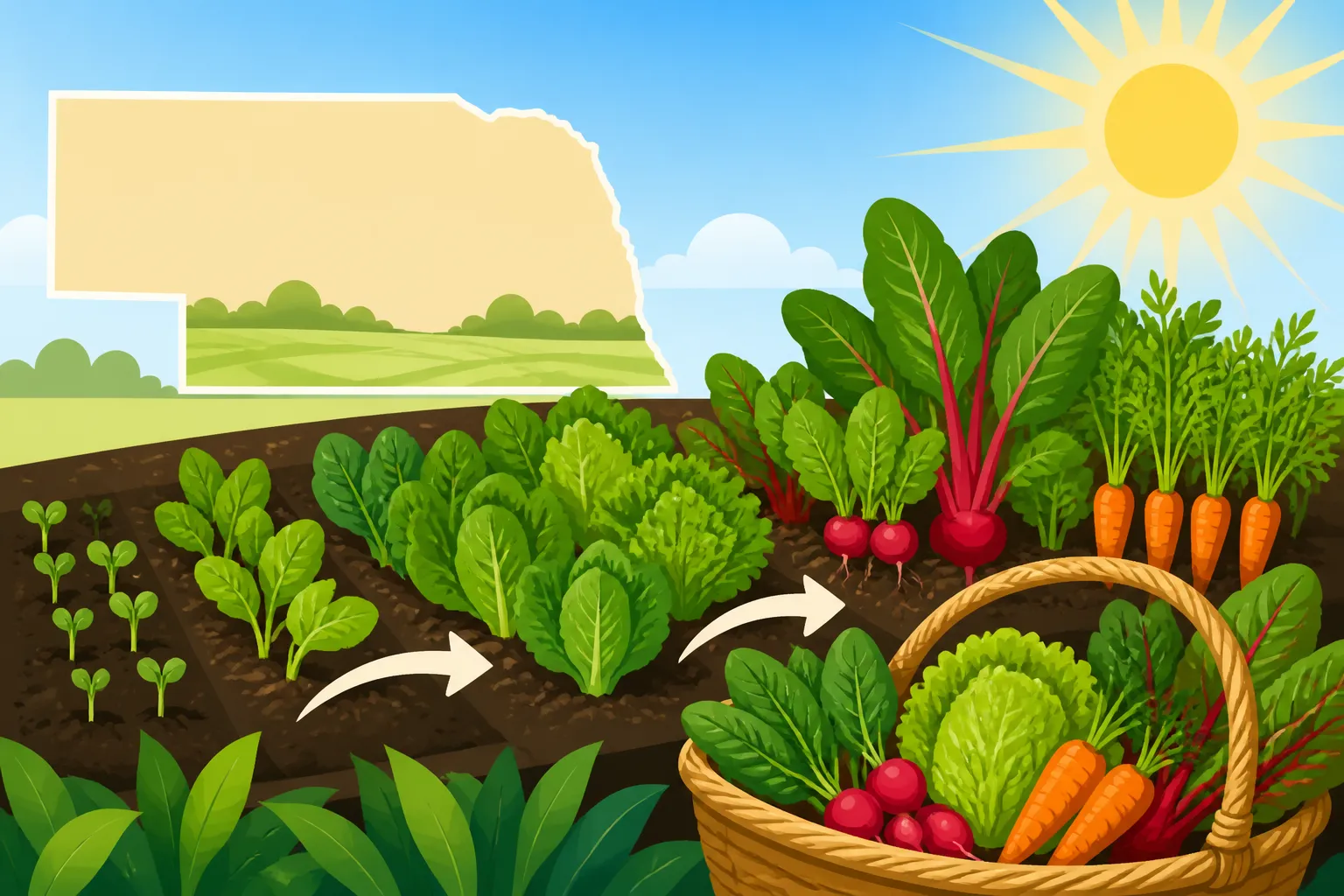
Nebraska Succession Planting: Steady Harvests All Summer
A garden can produce more food than a household can use, then leave a gap before the next crop is ready. Succession planting helps smooth out those ups and downs by spreading sowing dates, replacing harvested plants and making room work harder. This Nebraska-focused approach shows how to plan those rounds around crop pace, changing weather and the space you actually have.
Why succession planting works in Nebraska gardens
Succession planting is a way to plan several harvests from a garden bed over time instead of planting everything at once. It can mean sowing the same crop in separate rounds, planting a new crop where an earlier one was harvested, or using both methods in the same season.
The goal is not to keep every inch planted without a break. It is to match what you sow to what you can care for and eat, while leaving room to respond when Nebraska weather changes your plans.
A large planting of lettuce, radishes or other quick crops may seem efficient, but it can come ready all at once. If your household cannot use it promptly, some may lose quality before it reaches the table. Nebraska Extension in Lancaster County notes that staggered plantings of quick maturing crops like radishes, green onions or lettuce can help avoid a feast-or-famine harvest.
That is the basic benefit: instead of one large flush, you aim for smaller harvests spread across a longer stretch. The approach can also help you avoid gaps. When a crop finishes, a prepared bed can be replanted rather than left bare until you decide what to do next.
Nebraska’s growing conditions make flexibility especially useful. Spring may turn quickly from cool to warm, summer heat can challenge cool-season crops, and a later cool spell can affect warm-season plants. The right schedule varies with your garden’s location, exposure, soil and the weather in a particular year. Succession planting gives you a plan, but it should be a plan you can adjust.
It is also a practical way to make a small garden more productive. A bed does not need to be large to offer repeated harvests. A gardener with limited room can focus on crops that are eaten often, sow small rounds and replant only after the earlier crop is cleared. For a broader look at organizing beds, Nebraska Vegetable Garden Planning: Site, Soil, and Sun can help you consider light, soil and layout before choosing a schedule.
Succession planting works best when the planting decisions are connected. Before sowing, think through:
- What your household wants to eat regularly.
- How quickly each crop is likely to be used after harvest.
- Which bed or container will be ready next.
- Whether the next crop suits the season and current soil conditions.
- How much time you can give to watering, weeding and harvesting.
A schedule built around those questions is more useful than a calendar filled with sowing dates that do not match your garden or appetite.
Choose crops and planting methods that fit the plan
Not every crop needs to be planted in repeated rounds. Some produce for a concentrated period, while others can be harvested over time. Some take up a bed for a long stretch; others leave space for a follow-on crop relatively quickly. The best choices depend on how you cook, how much garden space you have and how reliably you can keep up with harvests.
Start with the crops you use most
Make a short list of vegetables and herbs that regularly show up in your meals. If you rarely eat a crop, planting it repeatedly is unlikely to create the steady harvest you want. A good succession plan starts with actual use, not the idea that every possible bed should be filled.
Quick crops can be useful for repeated sowing because a small new round can be added while an earlier round is still growing. That can spread the harvest and make it easier to judge how much you need. Lettuce, radishes and green onions are examples mentioned by Nebraska Extension in Lancaster County. Other crops may also suit repeated sowings, but their performance depends on season and growing conditions.
For crops that do not fit repeated sowing, consider whether they can be planted as a single crop and then followed by something else. A bed that held an early crop may be available for a later planting, provided there is enough time and the new crop suits the conditions.
Match the planting method to the crop
There are several useful ways to spread production:
- Repeat sowing: Plant a small new round of the same crop while an earlier round is growing or being harvested.
- Follow-on planting: Clear a finished crop and put a different crop in its place.
- Staggered varieties or maturity: Choose crops that do not all reach harvest at the same time, when suitable choices are available.
- A mixed approach: Sow a crop in rounds, then use the open space for a different crop after harvest.
The methods can overlap. For example, you might sow a quick crop in a bed, add another small sowing while the first is growing, then replace the area after the first harvest with a crop better suited to the later season.
Use the method that solves the problem you have. If too much produce becomes ready together, repeated sowings can spread the harvest. If a bed sits empty after harvest, follow-on planting can make better use of it. If you have trouble keeping seedlings watered, smaller sowings may be easier to manage than a large area of newly planted soil.
Consider how long each crop occupies space
A useful calendar records not just when you sow but what happens to the bed afterward. Some crops remain in place as you harvest; others are removed once the main harvest is done. That difference affects when you can plant again.
Before sowing, ask whether the crop is likely to leave the bed clear, whether you want to keep harvesting from it, and what could follow. Avoid treating a bed as available merely because some plants have been harvested. Remaining roots, stems or neighboring plants may still need space, light or care.
A simple bed record can include:
| What to track | Why it helps |
|---|---|
| Crop and bed or container | Shows where each planting is growing |
| Sowing or transplanting note | Helps you compare rounds and plan the next one |
| Germination and growth observations | Reveals whether weather or soil conditions slowed a planting |
| Harvest progress | Helps estimate when a bed may be ready for a follow-on crop |
| Next crop idea | Makes it easier to replant promptly without rushing the choice |
| Problems and adjustments | Helps you avoid repeating an approach that did not suit the site |
This does not need to be a formal spreadsheet. A notebook, garden sketch or simple list is enough if you can find and update it.
If you are deciding whether to sow directly or use indoor starts, Direct Sowing vs Indoor Seed Starts for Nebraska Garden Crops offers a way to compare those options. The important point for succession planning is to choose a method you can repeat consistently and that suits the crop.
Build a flexible succession calendar
A succession calendar is a decision aid, not a promise that every planting will be ready on schedule. Weather, soil moisture, plant health and the particular conditions of your garden all affect how a crop develops. Leave room for those variables rather than planning every bed to turn over at an exact moment.
Nebraska Extension in Lancaster County says planting a little seed every 7 to 10 days can help provide a continuous harvest. This interval can be a useful starting point when you are planning small rounds of suitable quick crops, but it is not a guarantee that every crop or season will produce at the same pace. Use the crop’s needs and your results to decide whether to continue, pause or change the approach.
Plan backward from meals and space
Begin with the harvest you hope to have. Do you want a small amount of greens available regularly? Are you hoping to avoid having all the roots ready together? Do you need an area free for a later crop? Those answers shape the size and timing of each planting.
Then work backward. Identify which bed or container can hold the crop, what needs to be removed first and whether the soil will be ready. Consider how you will water the new sowing without disrupting established plants. If the bed is not available when expected, have a backup location or a different crop in mind.
A useful calendar can be organized by planting round rather than by strict date:
- Current planting: What is growing now, and what does it need?
- Next small sowing: Is another round appropriate for this crop and season?
- Expected opening: What area may become available after harvest?
- Follow-on choice: Which crop is suitable for that opening?
- Weather check: What conditions could make you delay, protect or change the plan?
This structure helps you act when the garden is ready instead of assuming it will follow a fixed schedule.
Keep the plan small enough to maintain
A common mistake is to schedule more rounds than you can manage. Each sowing adds work: preparing soil, watering, watching for weeds, checking growth and harvesting. If a planting is small enough to care for but still worthwhile in the kitchen, it is more likely to be successful than an ambitious schedule that leaves seedlings neglected.
Start with a few crops you know your household will use. Record how much you planted and whether it was enough, too much or not enough. Use those observations to adjust later sowings. A small test round can be valuable when you are uncertain how a crop will behave in a particular bed or weather pattern.
There is no need for every crop to follow the same rhythm. Some may benefit from repeated small sowings, while others are better managed as one planting followed by a different crop. The calendar should describe your garden, not force every vegetable into one pattern.
Account for season changes
A crop that grows well in cool conditions may struggle as summer heat intensifies. A warm-season crop may not be a sensible follow-on choice if the remaining season and conditions do not suit it. Likewise, a late planting should not be assumed to mature simply because an earlier round did.
Use the expected season, the crop’s needs and current conditions to decide whether another sowing makes sense. For crop timing across Nebraska, Nebraska Cool-Season and Warm-Season Planting Guide provides helpful context. For planning a change from spring production to later crops, Nebraska Fall Gardening: Cool-Season Sowing Windows can help you think about the seasonal transition.
A calendar can include “review” points rather than only planting tasks. At each review, look at the plants, the forecast, the soil and your available time. If the bed is not ready or conditions are poor, waiting can be better than sowing into a situation that is likely to waste seed or effort.
Prepare beds so the next planting is ready
A succession plan can fall behind if each new sowing requires a full bed renovation. Preparation does not need to be elaborate, but it helps to make the next planting straightforward.
Keep an open space or a clear transition plan
Some gardeners reserve a small area for the next crop. Others plan to use space as soon as a crop is finished. Either approach can work. A reserved area offers flexibility when a bed is still occupied, while a transition plan makes it easier to replant promptly after harvest.
Do not confuse a clear patch with a ready seedbed. The soil may be compacted, dry, saturated or covered with plant material. Check its condition before sowing. If it needs attention, make that part of the transition rather than planting automatically.
When a crop is removed, clear plant debris that would interfere with sowing. Avoid disturbing soil more than necessary, particularly when it is wet. If the ground is too wet to work without smearing or clumping, delay the task until it is workable. Avoiding Hard Clods by Not Digging Wet Nebraska Garden Soil explains why soil condition matters when preparing a bed.
Use containers and small beds thoughtfully
Containers can make succession planting easier when ground space is limited. A container may be replanted after a crop finishes, or several containers can hold different rounds at once. The trade-off is that containers can dry out more quickly than in-ground beds, and new seedlings need consistent attention.
Use a suitable growing medium and make sure the container can drain. Keep new sowings accessible so you can check moisture and growth. Avoid adding more containers than you can water reliably during hot, windy or dry conditions.
For a small patio or balcony, staggered containers can provide a series of modest harvests without trying to fit every crop into one large planter. Using Balcony and Patio Planters for Nebraska Fresh Greens covers ways to grow greens where garden beds are not available. For container vegetables more broadly, Why Nebraska Patio Vegetables Need Container Mix Over Garden Dirt explains why the growing medium matters.
Make a realistic watering plan
Newly sown seed and established plants can need different care. A fresh seedbed may need attention to prevent the surface from drying, while older plants may need water reaching farther into the soil. If both are in the same area, use a watering approach that does not leave the new planting dry or keep the established crop unnecessarily wet.
Check the soil rather than relying on a fixed routine. Sun exposure, wind, soil texture, plant size and recent rain all affect how quickly a bed dries. Pay extra attention to new sowings during hot or windy weather, and make sure water reaches the area where the seeds or young roots are growing.
For more on keeping new plantings from drying out, see Keeping Summer Seedbeds Moist in Hot Nebraska Weather. If heat is affecting established vegetables, Watering Nebraska Beds in High Heat Without Overwatering can help you assess the balance between moisture and excess.
Keep records that answer practical questions
A planting record is useful only if it helps with decisions. Note what was planted, where it went, whether it came up well and how the harvest fit your household. Add a brief observation if a round failed, matured unevenly or proved difficult to keep watered.
You do not need to record every detail. Focus on information that can change a future choice:
- Was the planting too large for your household?
- Did the next round overlap too much with the first?
- Was the bed ready when you expected it to be?
- Did the crop struggle in heat, wind or dry soil?
- Did the follow-on crop have enough time and space?
Over time, these observations help you adapt general planting advice to your own yard. A calendar from another part of Nebraska may offer a useful starting point, but your site’s conditions matter.
Sow, monitor and adjust each round
The process is straightforward, but the best results come from paying attention after sowing. A calendar cannot tell you whether the seedbed is drying, whether plants are emerging evenly or whether a bed is ready to transition. Those checks help keep a succession plan on course.
Make each sowing manageable
Before adding another round, confirm that you can care for it. A small planting is easier to water, weed and harvest than a large one. It also gives you a chance to see whether the crop is still suitable for the conditions.
Prepare the seedbed according to the crop’s needs. Sow at the depth and spacing indicated on the seed packet or other reliable crop guidance. Do not assume every seed should be covered or spaced alike. Label each sowing so you can distinguish the new round from older plants, especially when the same crop appears in several places.
If sowing into an area that still has established plants, avoid crowding. Young seedlings need room and light, and the older crop may still need access for harvest. When the available space is tight, a separate small patch or container may be a better option.
Check emergence and moisture
After sowing, check the soil and seedling progress. If seedlings do not emerge as expected, consider whether the surface dried, the soil was too wet, the planting was disturbed or conditions were unsuitable. Do not repeat the same sowing automatically without trying to understand what happened.
Once seedlings are growing, remove competition while plants are small and water as needed based on soil conditions. Take care not to dislodge emerging seedlings. The aim is to keep the planting moving without giving it more water or attention than it needs.
A planting can fail even when the calendar looks right. That does not mean succession planting is a poor fit. It means the next round should reflect what you observed. You might shift the location, delay a sowing, select a different crop or skip that round.
Harvest with the next planting in mind
Harvest is part of the succession plan. If a crop is ready, regular picking can help you use it at good quality and make the next planting decision clearer. Leaving finished or declining plants in place can delay a bed change and keep the next crop waiting.
Before clearing an area, check whether any plants are still producing or whether a partial harvest would suit your needs. If you remove the whole crop, prepare the space for a follow-on planting only when the soil and season are suitable. There is no advantage in replacing a crop immediately if the next one is likely to struggle.
If you are unsure when a crop is ready, use crop-specific harvest signs rather than guessing from the planting date. For guidance on timing greens and roots in a repeated planting plan, Interval Seeding for Continuous Greens and Root Crops in Nebraska may help. For harvesting crops before cold weather changes the plan, Garden Harvest Decisions Before a Freezing Night addresses the decision to pick or wait.
Protect the plan from weather surprises
A succession schedule should be flexible enough to absorb delays. Heavy rain can make a bed difficult to work, hot conditions can make a cool-season sowing less suitable, and a cold spell can slow growth. Keep an alternative crop or a pause in mind rather than trying to force every planned sowing into the ground.
If you use covers to protect plants, monitor them as conditions change. Covers can create warmth, but they may also need attention during warm days. Keep them secure in wind and make sure the crop beneath them is not overheating. Ventilating Seedbed Row Covers During Warm Nebraska Spring Days and Securing Floating Row Covers Against Nebraska Spring Prairie Winds provide more detail on those specific concerns.
A missed sowing is not necessarily a problem. The purpose of succession planting is to improve continuity, not to fill every planned slot. If conditions do not suit the next round, it can be wiser to skip it and focus on the crops already growing.
Troubleshoot common succession planting problems
The most useful schedule is one that can be corrected. If the harvest is not as steady as you hoped, look at what caused the gap or surplus and adjust the next round rather than abandoning the whole approach.
Too much produce comes ready together
This usually means the rounds were too large, too close together, or the crop matured more evenly than expected. Reduce the size of future sowings, space rounds farther apart when appropriate or choose a crop that can be harvested gradually. You can also plant only what your household can reasonably use, then dedicate the freed space to a different crop.
Keep in mind that weather can compress or stretch the period between sowing and harvest. A planting record helps you see whether the overlap was caused by your schedule or by conditions that changed crop development.
There is a gap between harvests
A gap may happen because a later sowing was delayed, did not emerge, or took longer to grow than you expected. It may also mean the first crop remained in place longer than planned. If a bed is still occupied, consider whether another container or a separate small patch would help keep the next round moving.
Use the gap to improve the plan. Record when the earlier crop actually finished and what delayed the replacement. Then adjust the next calendar rather than assuming the same transition will happen at the same time again.
New seedlings struggle beside established plants
Older plants can shade or compete with seedlings, and it may be difficult to keep both at a suitable moisture level. If a sowing repeatedly struggles in the same spot, separate the rounds or move the new crop to a different area. A container or a small cleared patch may make care easier.
Check whether the crop is still appropriate for the season. Seedlings that emerge during increasingly hot conditions may need more protection and attention than expected. If the situation is unsuitable, switching to a crop better matched to the conditions can be more effective than trying to rescue every planting.
Beds are not ready when the calendar says they should be
The calendar may have assumed a harvest date that did not happen. Plants can grow more slowly in unfavorable conditions, and the soil may need time to dry or be prepared before the next sowing. Treat the planned date as a prompt to assess the bed, not an order to plant.
A practical plan includes a backup option. That might be another available bed, a container, a different crop or a pause. Should You Plant Now or Wait for Warmer Spring Ground? explores the value of checking actual soil and weather conditions before planting.
The garden becomes difficult to maintain
Too many overlapping rounds can turn a helpful system into a chore. Reduce the number of crops, simplify the recordkeeping and focus on planting sizes you can water and harvest. It is entirely reasonable to leave a bed unplanted for a while if that makes the rest of the garden easier to manage.
A successful succession garden is not the one with the most sowing dates. It is one that produces useful food at a pace you can handle. For ideas on simplifying crop choices, Easiest Vegetables for Nebraska Beginners in Small Spaces may help identify a manageable starting point.
Frequently Asked Questions
Does succession planting mean sowing every crop repeatedly?
No. Repeated sowing suits some crops and goals, while other crops may be better planted once and followed by a different crop. Choose the method based on how you use the harvest, how long the crop occupies space and the conditions when you plan to plant.
Should every planting round be the same size?
Not necessarily. Begin with a size you can care for and use, then adjust based on what you observe. Smaller rounds can be easier to manage and can reduce the chance that a large amount becomes ready together.
What if weather delays a planned sowing?
Check the crop, soil and current conditions before planting. A schedule is a guide, not a reason to sow into unsuitable conditions. You can delay, choose another crop, use another location or skip a round.
Can a small garden use succession planting?
Yes. A small bed or a few containers can support repeated small plantings. Focus on crops you use often, keep each planting manageable and plan what will happen when a crop is harvested.
How do I know whether the schedule is working?
Look at whether harvests are more useful and manageable, whether beds are being reused successfully and whether the workload remains reasonable. Record what happened and adjust the next planting round based on your own garden’s results.
Sources
- Nebraska Extension in Lancaster County — Vegetable Gardening for Beginners | Nebraska Extension in Lancaster County | Nebraska (checked November 15, 2026)
Disclaimer
This article is for general informational purposes only and does not constitute professional advice. Laws, prices and regulations vary by location and change over time. Consult a qualified professional for guidance on your specific situation. Nebraska Gardening Guide is not a government agency and is not affiliated with any university extension, state department of agriculture or other government agency.